
Ethical Challenges and Considerations in One Health Approaches to Emerging Infectious Diseases: A Descriptive Review
Abstract
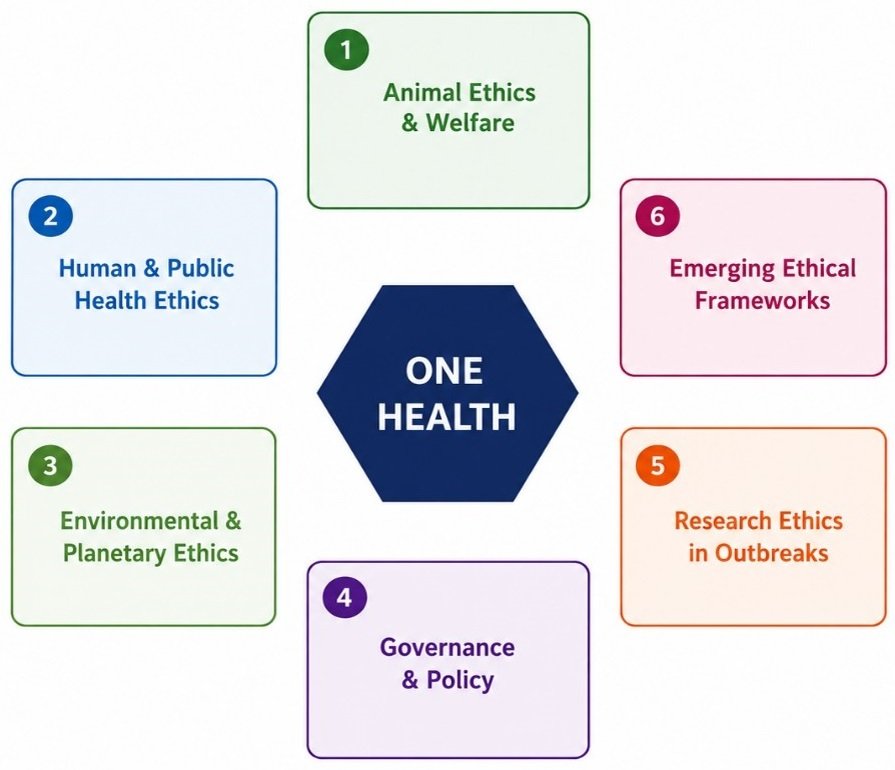
The One Health framework has emerged as a central paradigm for addressing emerging infectious diseases (EIDs) by recognizing the interconnectedness of human, animal, and environmental health. Despite increasing global adoption, the ethical dimensions of One Health remain conceptually fragmented and inconsistently operationalized across research, governance, and policy. This descriptive review synthesizes ethical challenges associated with One Health approaches to EIDs across six interrelated domains: animal ethics and welfare, public health ethics, environmental and planetary ethics, governance and policy, research ethics in outbreak settings, and emerging ethical frameworks. Drawing on peer-reviewed literature, policy documents, and conceptual scholarship, the review identifies four major cross-cutting ethical tensions. First, anthropocentric priorities continue to dominate One Health implementation, subordinating animal welfare and ecological integrity to human-centered outcomes. Second, tensions between collective welfare and individual rights become acute during outbreaks, imposing disproportionate burdens on marginalized populations. Third, persistent distributive, procedural, and epistemic injustices shape global and local responses, especially affecting low- and middle-income countries, indigenous communities, and non-human populations. Fourth, a substantial implementation gap exists between the articulation of ethical principles and their translation into enforceable institutional practice. The review further incorporates emerging ethical challenges related to antimicrobial resistance (AMR) within One Health contexts, empirical evidence from major outbreaks including COVID-19, Ebola, and avian influenza, and perspectives from Global South scholarship to address equity dimensions. Emerging frameworks, including One Health Ethics, Planetary Health Ethics, ethics of care, indigenous relational ethics, and epistemic justice approaches, offer promising foundations for more inclusive governance, yet remain insufficiently integrated into operational decision-making. The review argues that One Health ethics must evolve into a rigorous interdisciplinary field supported by practical governance tools, equitable research frameworks, transparent accountability mechanisms, and inclusive policymaking. Without such developments, the transformative potential of One Health will remain ethically and institutionally constrained.