
Ethical Challenges and Considerations in One Health Approaches to Emerging Infectious Diseases: A Descriptive Review
DOI:
https://doi.org/10.71320/bcs.0019Keywords:
One Health, emerging infectious diseases, animal welfare, public health ethics, environmental ethics, governanceAbstract
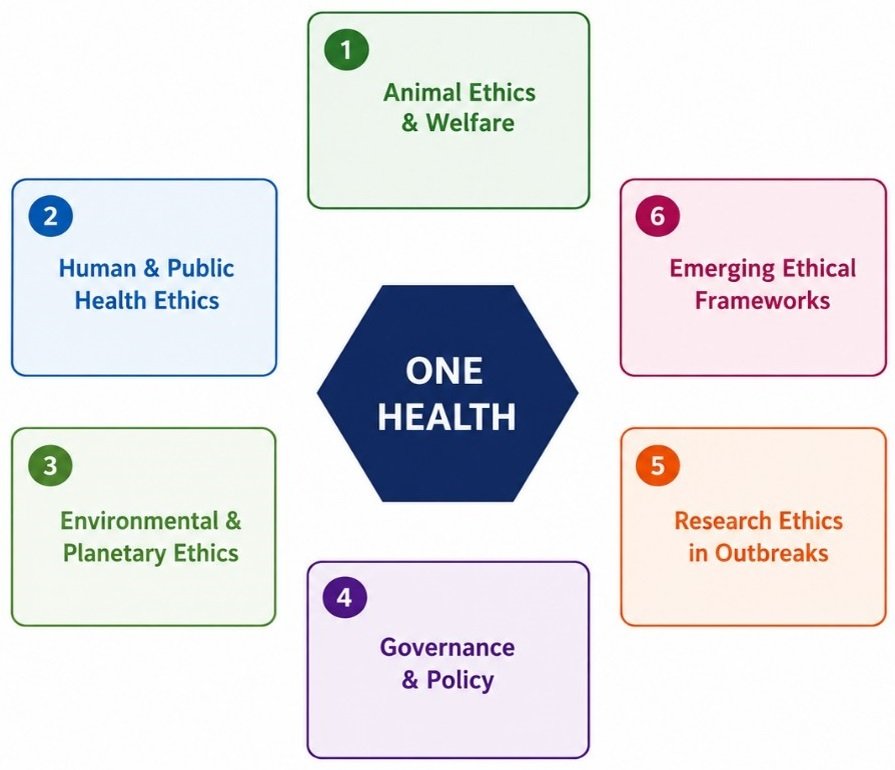
The One Health framework has emerged as a central paradigm for addressing emerging infectious diseases (EIDs) by recognizing the interconnectedness of human, animal, and environmental health. Despite increasing global adoption, the ethical dimensions of One Health remain conceptually fragmented and inconsistently operationalized across research, governance, and policy. This descriptive review synthesizes ethical challenges associated with One Health approaches to EIDs across six interrelated domains: animal ethics and welfare, public health ethics, environmental and planetary ethics, governance and policy, research ethics in outbreak settings, and emerging ethical frameworks. Drawing on peer-reviewed literature, policy documents, and conceptual scholarship, the review identifies four major cross-cutting ethical tensions. First, anthropocentric priorities continue to dominate One Health implementation, subordinating animal welfare and ecological integrity to human-centered outcomes. Second, tensions between collective welfare and individual rights become acute during outbreaks, imposing disproportionate burdens on marginalized populations. Third, persistent distributive, procedural, and epistemic injustices shape global and local responses, especially affecting low- and middle-income countries, indigenous communities, and non-human populations. Fourth, a substantial implementation gap exists between the articulation of ethical principles and their translation into enforceable institutional practice. The review further incorporates emerging ethical challenges related to antimicrobial resistance (AMR) within One Health contexts, empirical evidence from major outbreaks including COVID-19, Ebola, and avian influenza, and perspectives from Global South scholarship to address equity dimensions. Emerging frameworks, including One Health Ethics, Planetary Health Ethics, ethics of care, indigenous relational ethics, and epistemic justice approaches, offer promising foundations for more inclusive governance, yet remain insufficiently integrated into operational decision-making. The review argues that One Health ethics must evolve into a rigorous interdisciplinary field supported by practical governance tools, equitable research frameworks, transparent accountability mechanisms, and inclusive policymaking. Without such developments, the transformative potential of One Health will remain ethically and institutionally constrained.
References
Aarons, D. (2019). Addressing the challenge for expedient ethical review of research in disasters and disease outbreaks. Bioethics, 33(3), 343–346. DOI: https://doi.org/10.1111/bioe.12543
Anthony, R., & De Paula Vieira, A. (2022). One health animal disaster management: An ethics of care approach. Journal of applied animal welfare science, 25(2), 180–194. DOI: https://doi.org/10.1080/10888705.2022.2040360
Asundi, A., & Bhadelia, N. (2020). Making emergency use of experimental vaccines safer. AMA Journal of Ethics, 22(1), 43–49. DOI: https://doi.org/10.1001/amajethics.2020.43
Bambra, C., Riordan, R., Ford, J., & Matthews, F. (2020). The COVID-19 pandemic and health inequalities. J Epidemiol Community Health, 74(11), 964–968. DOI: https://doi.org/10.1136/jech-2020-214401
Basheer, A., Tran, M., Khan, B., Jentner, W., Wendelboe, A., Vogel, J., Kuhn, K., Wimberly, M. C., & Ebert, D. (2025). Comprehensive review of One Health systems for emerging infectious disease detection and management. One Health, 101253. DOI: https://doi.org/10.1016/j.onehlt.2025.101253
Bavel, J. J. V., Baicker, K., Boggio, P. S., Capraro, V., Cichocka, A., Cikara, M., Crockett, M. J., Crum, A. J., Douglas, K. M., & Druckman, J. N. (2020). Using social and behavioural science to support COVID-19 pandemic response. Nature human behaviour, 4(5), 460–471. DOI: https://doi.org/10.1038/s41562-020-0884-z
Bianchi, L. M. (2022). Obtaining Informed Consent for Research Studies. In Research During Medical Residency (pp. 139–156). CRC Press. DOI: https://doi.org/10.1201/9781003126478-9
Blaxter, T., Åsbjer, E., & Fraanje, W. (2024). Animal welfare and ethics in food and agriculture. Food Ethics, 1–44. DOI: https://doi.org/10.56661/f2d8f4c7
Brill, S. A., Guerrero-Martin, S. M., & Metcalf Pate, K. A. (2019). The symbiotic relationship between scientific quality and animal research ethics. ILAR journal, 60(3), 334–340. DOI: https://doi.org/10.1093/ilar/ilab023
Criscuolo, F., & Sueur, C. (2020). An evolutionary point of view of animal ethics. Frontiers in psychology, 11, 403. DOI: https://doi.org/10.3389/fpsyg.2020.00403
Damon, I. (2018). Preventative Medicine: Research and Use of Medical Countermeasures During an Outbreak. In Defence Against Bioterrorism: Methods for Prevention and Control (pp. 115–121). Springer. DOI: https://doi.org/10.1007/978-94-024-1263-5_9
Dawson, A., & Jennings, B. (2012). The place of solidarity in public health ethics. Public Health Reviews, 34(1), 4. DOI: https://doi.org/10.1007/BF03391656
De Briyne, N., Vidović, J., Morton, D. B., & Magalhães-Sant’Ana, M. (2020). Evolution of the teaching of animal welfare science, ethics and law in European veterinary schools (2012–2019). Animals, 10(7), 1238. DOI: https://doi.org/10.3390/ani10071238
Degeling, C., Johnson, J., Kerridge, I., Wilson, A., Ward, M., Stewart, C., & Gilbert, G. (2015). Implementing a One Health approach to emerging infectious disease: reflections on the socio-political, ethical and legal dimensions. BMC Public Health, 15(1), 1307. DOI: https://doi.org/10.1186/s12889-015-2617-1
Díaz, L., Zambrano, E., Flores, M. E., Contreras, M., Crispín, J. C., Alemán, G., Bravo, C., Armenta, A., Valdés, V. J., & Tovar, A. (2021). Ethical considerations in animal research: the principle of 3R's. Revista de investigacion clinica, 73(4), 199–209. DOI: https://doi.org/10.24875/RIC.20000380
Diller, E. R., & Williamson, L. (2023). Supporting one health for pandemic prevention: the need for ethical innovation. Journal of Bioethical Inquiry, 20(3), 345–352. DOI: https://doi.org/10.1007/s11673-023-10264-5
Edwards, K. M., & Kochhar, S. (2020). Ethics of conducting clinical research in an outbreak setting. Annual Review of Virology, 7, 475–494. DOI: https://doi.org/10.1146/annurev-virology-013120-013123
Estebanez, J., & Boireau, P. (2022). One Health: A social science discussion of a global agenda. Parasite, 29, 17. DOI: https://doi.org/10.1051/parasite/2022014
Fischhoff, B. (2012). Communicating uncertainty fulfilling the duty to inform. Issues in Science and Technology, 28(4), 63–70.
Folayan, M. O., Allman, D., Haire, B., Yakubu, A., Afolabi, M. O., & Cooper, J. (2019). Considerations for community engagement when conducting clinical trials during infectious disease emergencies in West Africa. Developing world bioethics, 19(2), 96–105. DOI: https://doi.org/10.1111/dewb.12215
Fricker, M. (2007). Epistemic injustice: Power and the ethics of knowing. Oxford university press. DOI: https://doi.org/10.1093/acprof:oso/9780198237907.001.0001
Grace, D., Mutua, F. K., Ochungo, P., Kruska, R. L., Jones, K., Brierley, L., Lapar, M. L., Said, M. Y., Herrero, M., & Phuc, P. (2012). Mapping of poverty and likely zoonoses hotspots.
Han, Z., Wang, J., Zhang, K., & Tang, Q. (2020). The ethics of COVID-19 clinical trials: new considerations in a controversial area. Integrative Medicine Research, 9(3), 100425. DOI: https://doi.org/10.1016/j.imr.2020.100425
Haskins, M. H. (2020). Ethical challenges in health research during global health emergencies. South African General Practitioner, 1(3), 123–125. DOI: https://doi.org/10.36303/SAGP.2020.3.0029
Hawryluck, L., Gold, W. L., Robinson, S., Pogorski, S., Galea, S., & Styra, R. (2004). SARS control and psychological effects of quarantine, Toronto, Canada. Emerging infectious diseases, 10(7), 1206. DOI: https://doi.org/10.3201/eid1007.030703
Jesudason, T. (2023). A one health priority research agenda for AMR. The Lancet Microbe, 4(10), e769. DOI: https://doi.org/10.1016/S2666-5247(23)00242-2
Jones, K. E., Patel, N. G., Levy, M. A., Storeygard, A., Balk, D., Gittleman, J. L., & Daszak, P. (2008). Global trends in emerging infectious diseases. Nature, 451(7181), 990–993. DOI: https://doi.org/10.1038/nature06536
Kallas, E. G., & O’Connor, D. H. (2016). Real-time sharing of Zika virus data in an interconnected world. JAMA pediatrics, 170(7), 633–634. DOI: https://doi.org/10.1001/jamapediatrics.2016.0857
Knox, J. H. (2017). Report of the special rapporteur on the issue of human rights obligations relating to the enjoyment of a safe, clean, healthy and sustainable environment: biodiversity report. United Nations Human Rights Council, A/HRC/34/49, Wake Forest Univ. Legal Studies Paper.
Lainé, N. (2023). The challenges of One Health. Accessing and networking with different forms of knowledge and epistemologies. CABI One Health(2023), ohcs202300016. DOI: https://doi.org/10.1079/cabionehealth.2023.0016
Lane, H. C., Marston, H. D., & Fauci, A. S. (2016). Conducting clinical trials in outbreak settings: Points to consider. Clinical trials, 13(1), 92–95. DOI: https://doi.org/10.1177/1740774515618198
Lederman, Z. (2025). Towards an ethical analysis of research in one health (EAROH). Journal of Bioethical Inquiry, 22(2), 395–404. DOI: https://doi.org/10.1007/s11673-024-10406-3
Lee, K., & Brumme, Z. L. (2013). Operationalizing the One Health approach: the global governance challenges. Health policy and planning, 28(7), 778–785. DOI: https://doi.org/10.1093/heapol/czs127
Littler, J. (2017). Against meritocracy: Culture, power and myths of mobility. Routledge. DOI: https://doi.org/10.4324/9781315712802
Machalaba, C. C., Salerno, R. H., Barton Behravesh, C., Benigno, S., Berthe, F. C., Chungong, S., Duale, S., Echalar, R., Karesh, W. B., & Ormel, H. J. (2018). Institutionalizing One Health: from assessment to action. Health security, 16(1_suppl), S–37–S–43. DOI: https://doi.org/10.1089/hs.2018.0064
Mertz, M., Hetzel, T., Alex, K., Braun, K., Camenzind, S., Dodaro, R., Jörgensen, S., Linder, E., Capas-Peneda, S., & Reihs, E. I. (2024). Interdisciplinary Animal Research Ethics—Challenges, Opportunities, and Perspectives. Animals, 14(19), 2896. DOI: https://doi.org/10.3390/ani14192896
Mormina, M., Suwalowska, H., & Schneiders, M. L. (2024). Participant recruitment, consent and post-trial access to interventions. In Research ethics in epidemics and pandemics: A casebook (pp. 173–192). Springer.
Morse, S. S., Mazet, J. A., Woolhouse, M., Parrish, C. R., Carroll, D., Karesh, W. B., Zambrana-Torrelio, C., Lipkin, W. I., & Daszak, P. (2012). Prediction and prevention of the next pandemic zoonosis. The Lancet, 380(9857), 1956–1965. DOI: https://doi.org/10.1016/S0140-6736(12)61684-5
Msemakweli, J. G., Mzuka, K., & Osward, A. (2024). One health approach to antimicrobial resistance: integrating human, animal, and environmental perspectives. Journal of Public Health and Community Medicine, 1(4), 132–142. DOI: https://doi.org/10.5455/JPHCM.20240918103501
Nichol, A. A., & Antierens, A. (2021). Ethics of emerging infectious disease outbreak responses: Using Ebola virus disease as a case study of limited resource allocation. PLoS One, 16(2), e0246320. DOI: https://doi.org/10.1371/journal.pone.0246320
Noddings, N. (2013). Caring: A relational approach to ethics and moral education. Univ of California Press.
Nouvet, E., Hunt, M., & Schwartz, L. (2022). “Is There Anything Else You Would Like to Add?”: The Ethics of (Not) Addressing Research Participants' Top Concerns in Public Health Emergency Health Research. Frontiers in Public Health, 10, 796414. DOI: https://doi.org/10.3389/fpubh.2022.796414
Organization, W. H. WHO.(2015). Global action plan on antimicrobial resistance. Geneva: World Health Organization. In: WHO Press, Geneva, Switzerland.
Organization, W. H. (2022). Joint external evaluation tool: international health regulations (2005). World Health Organization.
Organization, W. H., Programme, U. U. N. E., & Health, W. O. f. A. (2022). One health joint plan of action (2022‒2026): working together for the health of humans, animals, plants and the environment. World Health Organization.
Patz, J. A., Daszak, P., Tabor, G. M., Aguirre, A. A., Pearl, M., Epstein, J., Wolfe, N. D., Kilpatrick, A. M., Foufopoulos, J., & Molyneux, D. (2004). Unhealthy landscapes: policy recommendations on land use change and infectious disease emergence. Environmental health perspectives, 112(10), 1092. DOI: https://doi.org/10.1289/ehp.6877
Prainsack, B., & Buyx, A. (2012). Solidarity in contemporary bioethics–towards a new approach. Bioethics, 26(7), 343–350. DOI: https://doi.org/10.1111/j.1467-8519.2012.01987.x
Ravinetto, R., Adhiambo, J., & Kimani, J. (2024). Research ethics preparedness during outbreaks and public health emergencies: focus on community engagement. Research Ethics, 20(4), 731–743. DOI: https://doi.org/10.1177/17470161241254169
Rodriguez, J. (2024). One Health ethics and the ethics of zoonoses: A silent call for global action. Veterinary Sciences, 11(9), 394. DOI: https://doi.org/10.3390/vetsci11090394
Rüegg, S. R., McMahon, B. J., Häsler, B., Esposito, R., Nielsen, L. R., Ifejika Speranza, C., Ehlinger, T., Peyre, M., Aragrande, M., & Zinsstag, J. (2017). A blueprint to evaluate One Health. Frontiers in Public Health, 5, 20. DOI: https://doi.org/10.3389/fpubh.2017.00020
Saxena, A., Horby, P., Amuasi, J., Aagaard, N., Köhler, J., Gooshki, E. S., Denis, E., Reis, A. A., & Ravinetto, R. (2019). Ethics preparedness: facilitating ethics review during outbreaks-recommendations from an expert panel. BMC medical ethics, 20(1), 29. DOI: https://doi.org/10.1186/s12910-019-0366-x
Selgelid, M. J. (2009). A moderate pluralist approach to public health policy and ethics. Public Health Ethics, 2(2), 195–205. DOI: https://doi.org/10.1093/phe/php018
Sheather, J. (2023). One Health and climate change—we need to get the ethics right. In (Vol. 383): British Medical Journal Publishing Group. DOI: https://doi.org/10.1136/bmj.p2177
ten Have, H., & Patrão Neves, M. d. C. (2021). Animal Welfare (See Animal Ethics; Animal Research; Animal Rights). In Dictionary of Global Bioethics (pp. 121–122). Springer. DOI: https://doi.org/10.1007/978-3-030-54161-3_441
Van Boeckel, T. P., Gandra, S., Ashok, A., Caudron, Q., Grenfell, B. T., Levin, S. A., & Laxminarayan, R. (2014). Global antibiotic consumption 2000 to 2010: an analysis of national pharmaceutical sales data. The Lancet infectious diseases, 14(8), 742–750. DOI: https://doi.org/10.1016/S1473-3099(14)70780-7
Van Herten, J. (2021). Considerations for an ethic of One Health: towards a socially responsible zoonotic disease control Wageningen University and Research].
van Herten, J., Buikstra, S., Bovenkerk, B., & Stassen, E. (2020). Ethical decision-making in zoonotic Disease Control: how do one health strategies function in the Netherlands? Journal of Agricultural & Environmental Ethics, 33(2). DOI: https://doi.org/10.1007/s10806-020-09828-x
Venkatapuram, S. (2022). Ethics and global health emergencies. Current History, 121(838), 291–297. DOI: https://doi.org/10.1525/curh.2022.121.838.291
Whitmee, S., Haines, A., Beyrer, C., Boltz, F., Capon, A. G., de Souza Dias, B. F., Ezeh, A., Frumkin, H., Gong, P., & Head, P. (2015). Safeguarding human health in the Anthropocene epoch: report of The Rockefeller Foundation–Lancet Commission on planetary health. The Lancet, 386(10007), 1973–2028. DOI: https://doi.org/10.1016/S0140-6736(15)60901-1
Wolf, P. J., & Schaffner, J. E. (2019). The road to TNR: Examining trap-neuter-return through the lens of our evolving ethics. Frontiers in Veterinary Science, 5, 341. DOI: https://doi.org/10.3389/fvets.2018.00341
Yeates, J. W. (2024). Animal behaviour and welfare research: A One Health perspective. Research Ethics, 20(3), 411–432. DOI: https://doi.org/10.1177/17470161241236941
Yopa, D. S., Massom, D. M., Kiki, G. M., Sophie, R. W., Fasine, S., Thiam, O., Zinaba, L., & Ngangue, P. (2023). Barriers and enablers to the implementation of one health strategies in developing countries: a systematic review. Frontiers in Public Health, 11, 1252428. DOI: https://doi.org/10.3389/fpubh.2023.1252428
Zhou, Y., Frutos, R., Bennis, I., & Wakimoto, M. D. (2024). One Health governance: Theory, practice and ethics. Science in One Health, 3, 100089. DOI: https://doi.org/10.1016/j.soh.2024.100089
Published
Data Availability Statement
This is a descriptive review study. No new data were generated or analyzed in this work. All information is derived from previously published literature.
Issue
Section
Categories
License
Copyright (c) 2026 Bio Communications

This work is licensed under a Creative Commons Attribution-NonCommercial-NoDerivatives 4.0 International License.
Copyright © Bio Communications. This article is published under the terms of the Creative Commons Attribution-NonCommercial-NoDerivatives 4.0 International (CC BY-NC-ND 4.0) license. Under this license, you are free to share (copy and redistribute) this material in any medium or format for non-commercial purposes, provided you give appropriate credit to the author(s) and the journal. No modifications or adaptations of the material are permitted. The copyright for this article remains with the journal Bio Communications.
How to Cite
Plaudit





 .
.